

TL;DR: Published numbers from the two surveys in the monthly jobs report disagree about the gap in employment growth for men and women over the past year; the household survey says it’s ~2.4 million, and the establishment survey says it’s ~400K. The household survey is absolutely wrong in this case, and the establishment survey is much closer to the truth.
More below chart.
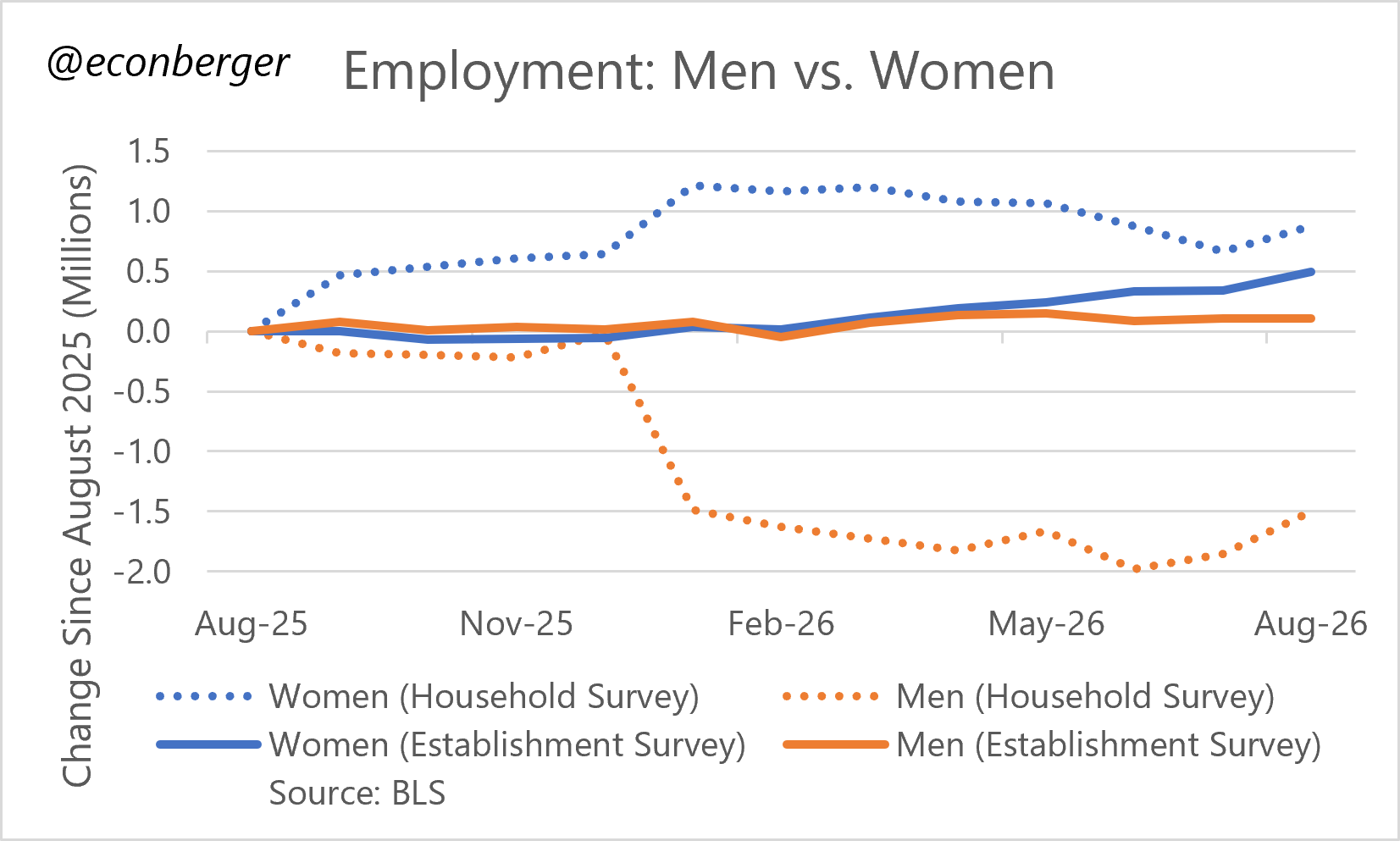
Over the weekend there were several active threads on social media citing a supposedly enormous gap in employment growth between men and women. One version cited an increase of 873K in employment of women over the past year, and a decline of 1,497K in the employment of men over the same period (so a 2.370 million gap). Another cited data that in August, employment of women rose by 158K and employment of men by just 4K. The first set of numbers accurately cites published data, but the data are wrong; the second set of numbers come from data that probably isn’t wrong, but reflects fairly small magnitudes.
The place to start: the monthly employment report is based on two surveys, the Current Population Survey (CPS or “household survey”) and the Current Employment Statistics (CES or “establishment survey”). As you can guess from the names, the former is a survey of households/people and the second is a survey of establishments/businesses. You can construct employment counts from both surveys; both have their strengths and weaknesses, and economists tend to compare them from time to time. The count that comes out of the establishment survey, known as “nonfarm payroll employment”, is what generates monthly headlines like “the economy added +162,000 jobs in August”.
Each of these counts is also dependent on a substrate of data outside the scope of the survey. For instance, in the last few years, the annual benchmark revision of nonfarm payroll employment has generated news and (unfortunately) conspiracy theories. The household survey’s substrate is the Census Bureau’s population estimates, which undergo a recalculation every year.
And while the household survey doesn’t undergo meaningful historical revisions in the same way as the establishment survey, every year in early February (as part of the January jobs report) the BLS implements “population controls” - a one-time adjustment to the population counts underlying the household survey data, using the updated Census population data. The population data update flows downstream to every series in the household survey. For instance, the latest set of population controls caused a net reduction in the estimated number of men over age 16 by -1.54 million and an increase in the estimated number of women over age 16 by +1.31 million. And this resulted in a -1.59 million reduction in the number of employed men over age 16, and a 155K increase in the number of employed women.1
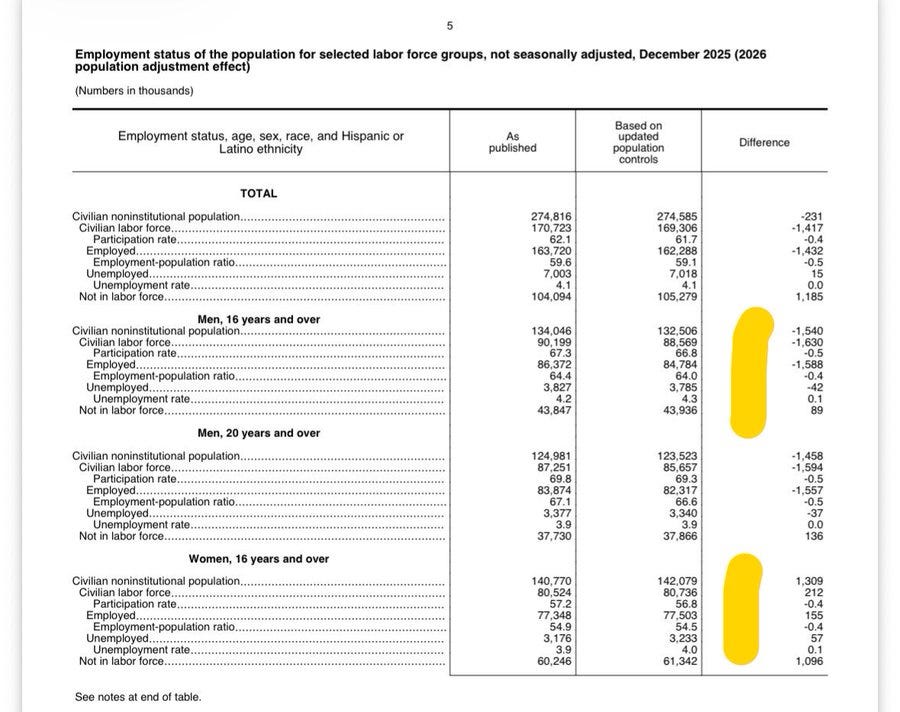
I want to reiterate that these population controls are not “real” in the sense of a real-world event that happened in January of 2026. They’re a correction of prior mis-counts. If you want to understand what happened to employment or various other household survey counts across the December 2025-January 2026 boundary, you have to strip them out.
So turning back to the original chart, you can pretty clearly see what happened in January 2026. The population controls generated a big jump in “employment” of women and a very big drop in the “employment” of men. Without them, we’d be tracking a much smaller employment gender gap in the household survey, close in magnitude to the establishment survey over the same period.23
Zooming out, this is at least the 2nd time this year that these population controls have caused erroneous interpretations of time series household survey data by savvy data consumers; a few months ago, it led folks to overestimate recent declines in the labor force participation rate. This raises the question of whether the BLS should reconsider its historical tradition of not meaningfully revising the household survey data; with such a revision, the entire time series would use up to date Census population estimates and be more comparable across December/January boundaries. The BLS does publish “experimental series” for the headline series, but not for key sub-measures of interest (e.g. prime working age employment population ratio, part time for economic reasons, etc).
I’ll wrap up with the significance of the “truth”: the establishment survey still shows a (much smaller) gap in employment growth over the past year. But is +158K / +4K month-over-month in August a big deal? It certainly would be if it continued month after month after month. But the fact that the 12 month gap in August isn’t way larger than the 1-month gap should give you pause. These data are noisy. My guess is August is an outlier/exaggeration of a smaller, slower-moving phenomenon.
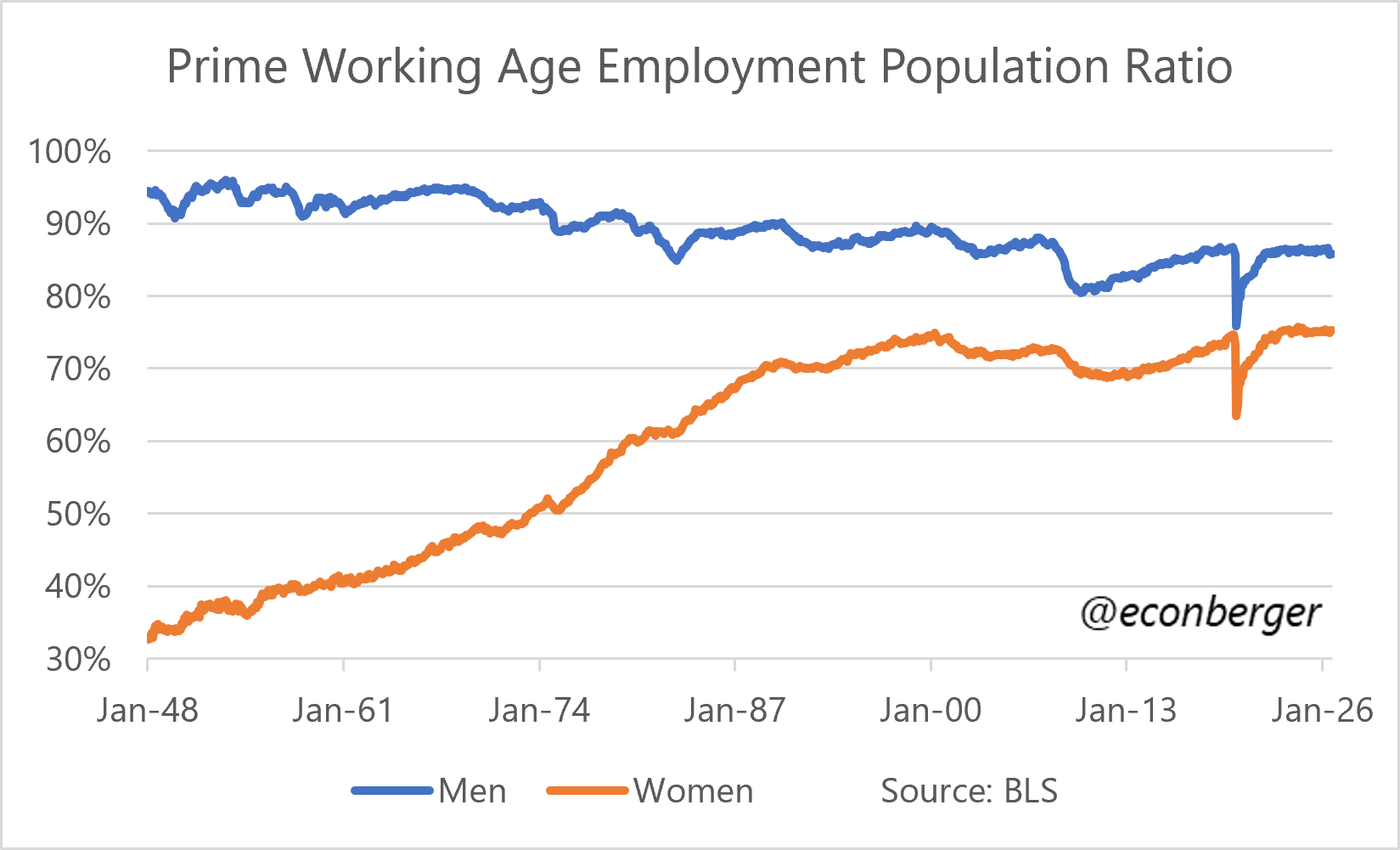
I’ll close this note with a big picture observation: over the past 76 years, the gap in prime working age employment between men and women has narrowed sharply. Most of that narrowing was over by the late 1990s, but it’s continued on a small scale since. It would not be surprising or concerning to see it narrow further in the years ahead, and that would imply slightly faster employment growth for women than for men.
The main reason why we didn’t see much change in the employment of women over 16 is that a lot of the population measurement delta came from previously-undercounted older women.
The establishment survey is susceptible to future revisions, but I will bet dollar to donuts that they won’t grow this gap into 7 figures (and it’s possible they’ll shrink it).
The surveys disagree on timing after such an adjustment: the household survey says the gap widened in late 2025 and early 2026, the establishment survey says the widening happened in the spring and summer of 2026.
Does a similar effect apply to other demographic factors like age, race, and native born cohorts?
Typo: "For instance, the latest set of population controls caused a net reduction in the estimated number of men over age 16 by -1.54 million and an increase in the estimated number of [men] *women* over age 16 by +1.31 million"